The general condition of your cat's skin and coat are good indicators of her health. Although health and nutrition influence the shine and texture of your cat's coat from the inside, regular grooming and skin care on the outside will help keep your cat's coat clean and free of tangles, no matter what type of hair coat she has.
What are the different types of hair coats that a cat might have?
Selective breeding has led to cats with several coat characteristics ranging from the hairless Sphinx cats to fluffy, long-haired breeds. Some cats shed very little, such as the Sphinx and the Rex breeds. Most other breeds of cats have a smooth outer coat of guard hairs and a fine undercoat of soft hairs that provide additional insulation. Long-haired breeds of cats often have very fine silky outer coats that may tangle very easily.
Some cats that live in cooler climates, particularly if they frequently venture outdoors, undergo two heavy seasonal shedding cycles per year (late spring and late fall), during which much of the undercoat falls out in clumps. However, many cats that share our homes shed their undercoat and guard hairs at low levels all year round.
How often should I groom my cat?
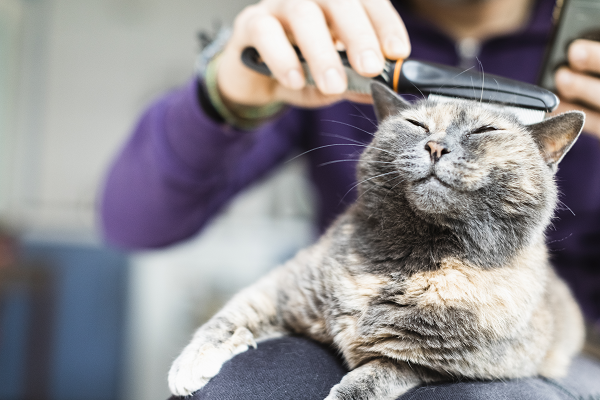
All cats benefit from regular brushing to remove loose hairs and dead skin cells, keep the coat free of dirt, debris, and external parasites, and distribute natural skin oils along the hair shafts. Cats with long, silky, or curly coats require daily brushing to keep their hair from becoming tangled or matted, especially around the ears, in the armpits, or along the back of the legs. Cats with short hair coats may require less frequent brushing.
"Daily brushing will reduce the amount of hair a cat swallows during self-grooming with her tongue, therefore helping to reduce the number of hairballs your cat may develop."
In addition to benefiting your cat, daily brushing will dramatically reduce the amount of loose hair and cat dander floating around the home. For some people with mild cat allergies, daily brushing may even reduce the number of airborne allergens enough that they can share their home with a cat.
Regardless of the type of hair coat, you should inspect your cat's coat daily to ensure there are no tangles or clumps that have developed under the armpits, in the groin, or behind the ears. If you regularly check your cat's coat and skin, you will also have a better chance of detecting any unusual lumps, bumps, or areas of sensitivity on your cat's body.
What type of brush or comb should I use?
Different styles of brushes work better on certain types of hair coats. Stiff bristle brushes will help remove loose hairs from cats with short coats or sparse undercoats, while long-toothed metal combs or brushes, especially ones with rows of offset tines, are helpful to remove loose hair and smooth minor tangles in medium and long-haired cats. Some combs are designed to remove clumps of loose undercoat if your cat is undergoing a heavy seasonal shedding or gently teasing out smaller mats behind the ears or along the back legs of long-haired cats.
Whatever the choice of brush you use, it is important to be gentle when using it and to avoid excessive pulling on tangles. Your veterinary health care team can give you specific recommendations for grooming tools that will work particularly well for your cat's coat type.
How should I remove tangles, mats, or burrs?
If a tangle is small or relatively minor, or if your cat has just picked up a burr or grass awn, you may be able to remove it by brushing or combing it out gently. If the tangle is extensive or there is a large clump of burrs or grass awns forming a mat, it may be necessary to cut out the clump of hair. In this case, you need to be extremely CAREFUL that you do not accidentally cut your cat's skin. For this reason, scissors are never recommended, and clippers should be used. When tangles are severe or extensive, it is strongly recommended that you seek professional care from a groomer or your veterinarian. If a mat has caused any skin irritation, take your cat to your veterinarian so that the appropriate treatment can be prescribed.
If you are planning on bathing your cat, make sure that you brush out as many burrs or tangles from the coat BEFORE bathing since tangles can become impossible to remove after a bath!
How often should I bathe my cat?
Most healthy adult cats are fastidious groomers and rarely require a bath. How often your cat needs to be bathed will vary with age, lifestyle, and underlying health status. For example, an arthritic or overweight cat that has difficulty grooming herself may need the occasional bath to remove loose hair and objectionable odors. If your cat has allergies, your veterinarian may prescribe frequent bathing as part of the treatment regime.
"How often your cat needs to be bathed will vary with age, lifestyle, and underlying health status."
If you find that your cat requires frequent bathing, discuss this with your veterinarian, who may recommend using a 'dry shampoo' or a special shampoo and conditioning rinse to prevent skin problems associated with the repeated baths.
Can I use baby shampoo?
No. Cats should only be bathed with a shampoo formulated for use on cats - their skin has a different thickness and pH (acidity) than human skin. Human shampoo, including baby shampoo, is far too harsh for their skin. A hypoallergenic shampoo without any added perfumes is the best choice for routine bathing. It is best to ask your veterinarian which shampoo is best for your cat.
How should I bathe my cat?
Bathing cats can be challenging because most of them strongly dislike water. While kittens can be trained early to accept baths, adult cats often resist the process, making it harder for owners. Because of this, many people prefer taking their cats to a professional groomer or having them bathed under light sedation at a veterinary clinic for safety.
If you choose to bathe your cat at home, always use warm water for comfort and better cleaning. Most owners bathe their cats in a sink, laundry tub, or bathtub. Since cats rarely stay still in water, groomers suggest dipping the cat to wet the fur, applying the shampoo while the cat stands on a dry surface, and rinsing either under running water or by dipping again if the water stream causes stress. Always keep a firm hold on all four feet to prevent the cat from escaping or causing injury.
After applying shampoo, make sure to work it through the entire coat to remove dirt and oils. For cats with very thick fur, diluting the shampoo with water can make it easier to lather and rinse. Routine shampoos can be rinsed off right away, but medicated shampoos need to stay on the coat for 5–10 minutes, so always follow the instructions on the label or your veterinarian’s advice.
Once the shampoo has done its job, rinse thoroughly to remove all residue. Applying a conditioner afterward can help restore moisture to the skin and reduce dandruff. Since cats groom themselves immediately after bathing, it is important to ensure no shampoo or product is left behind, especially when using medicated or flea shampoos, to avoid any risk of irritation or toxicity.
Should I have my long-haired cat shaved down in the summer?
Most cats, even those with long hair, cope very well with hot summer temperatures without needing a haircut. However, long-haired cats prone to getting large mats in their fur or cats that do not groom themselves well and object to regular brushing may benefit from having their hair shaved down periodically.
In some cases, the cat will require sedation during this procedure since few cats will tolerate the noise of the clippers or the discomfort of extensive mat removal while awake and alert. If your cat requires a haircut in the summer months, it is important to leave at least 1” (2.5 cm) of haircoat to avoid sunburn or sun damage to the skin.
"If your cat requires a haircut in the summer months, it is important to leave at least 1” (2.5 cm) of haircoat to avoid sunburn or sun damage to the skin."
Are there any other recommendations?
Your take-home message is that your cat's general coat appearance may be the first indicator of health problems. A healthy animal will not shed excessively and have a shiny coat free from dandruff or greasiness. Before reaching for the bottle of shampoo, think about whether that lackluster coat could be telling you something else. If your cat is older, she may suffer from arthritic pain that prevents her from adequately grooming herself. If your cat is overweight, she may have difficulty reaching certain areas of her body. It is best to contact your veterinary clinic to arrange for a consultation so that you can help keep your cat both healthy and happy.
Summary
- A cat’s coat reflects its overall health, and regular grooming helps keep it clean, tangle-free, and healthy.
- Coat types vary (hairless to long-haired), and some cats shed seasonally while others shed lightly year-round.
- Long-haired cats need daily brushing, while short-haired cats need less, helping reduce hairballs and allergens.
- Use appropriate brushes for the coat type, be gentle with tangles, and seek professional help for severe mats.
- Cats rarely need baths; use only cat-safe shampoo, rinse thoroughly, and follow vet instructions for medicated products.
- Shaving is rarely necessary, but if done, leave at least 1 inch of fur to prevent sunburn.
- A dull or unkempt coat may signal health issues—consult a veterinarian if noticed.